Guide · 7 min read
Choosing a home sauna: a guide from our design desk
Choosing a home sauna comes down to four decisions in order: where the cabin sits, how many people use it, what wood and heater go inside, and then the budget. The order matters — clients who start from the wood catalogue often have to back up two steps once they learn what their home's power supply can handle. This guide follows the same order we use when we design saunas for homes across Tangerang.
Step 1 — pick the location: indoors or in the garden?
Indoors means a custom cabin that follows the room: a former storeroom, a corner of the master bathroom, or a dedicated space. The first thing to check isn't the room itself but three routes: power to the panel, ventilation in and out, and access for carrying materials in. In the garden, the choice is an outdoor cabin — more generous on size, but in Tangerang's climate it must sit under a protective roof: heavy rain and UV are wood's worst enemies. Details on both types are on the Tangerang sauna page.
Step 2 — size: be honest about how many use it
Rule of thumb: size follows your regular users, not the guests who visit once a year.
| Capacity | Size | Heater | Power |
|---|---|---|---|
| 2 people | 1.5×1.2 m | 3.6 kW | 5,500 VA |
| 4 people | 2×2 m | 6 kW | 7,700 VA |
| 6 people | 2.4×2 m | 8 kW | 11,000 VA |
| 8 people | 3×2.4 m | 9 kW | 11,000 VA |
A 2-person cabin really is tight — one short bench, walls within arm's reach. If you want to lie down, the bench needs to be at least 1.8 m long, which puts you in the 4-person class. Watch the power column: that's the hidden cost we get into in step 4.
Step 3 — wood and heater: this is where quality lives
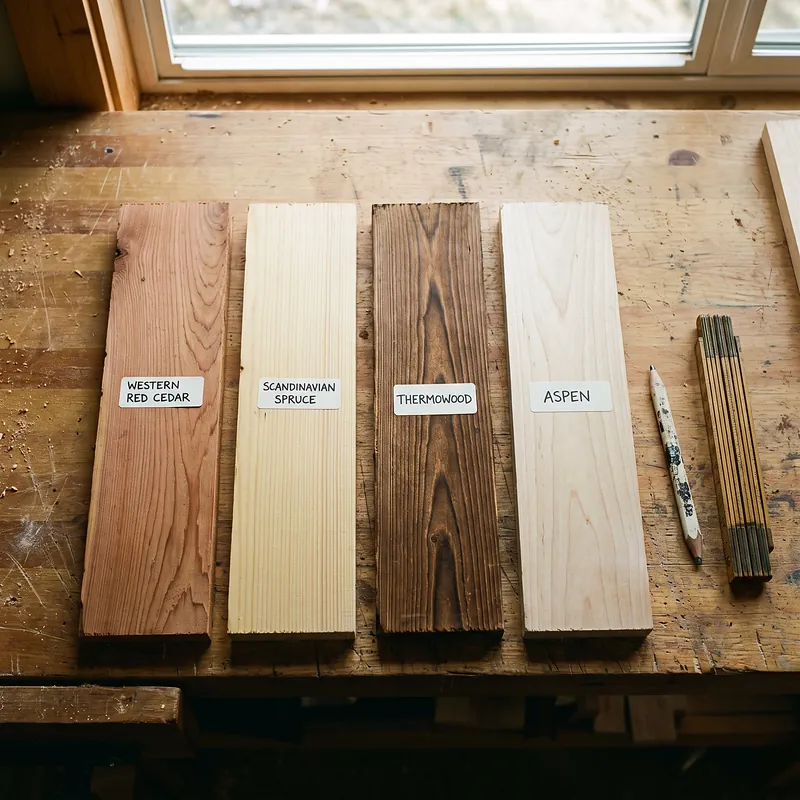
Interior wood — three choices proven in the tropics: western red cedar (aromatic, stable, the most premium), Scandinavian spruce (light, economical), and thermowood (wood baked until stable, with a deep brown colour). Benches are always aspen or abachi — their low density means they won't burn your skin at 90°C. What we turn down: local hardwoods like ulin and bengkirai on the interior. They're superb for an outdoor deck, but inside a sauna they get too hot to touch.
Heaters — we only fit imported brands with an official warranty and spare parts in Indonesia: Harvia (Finland), Sawo, Tylo. The factory warranty runs 1–2 years, on top of our 2-year construction warranty. An unbranded heater is cheaper up front and dearer when it fails: no spares, no service.
Step 4 — electricity: the decision that drives everything
Older homes in Karawaci, Cipondoh, and Ciputat are usually on 2,200–5,500 VA. A 6–9 kW heater demands 7,700–11,000 VA — meaning a PLN power upgrade (billed at the official tariff, and we help arrange it) plus a heat-resistant SiHF cable run with its own breaker and ELCB. If upgrading isn't possible, the way out is an infrared sauna: carbon panels of 1.7–2.4 kW that run on standard supply, working at 45–60°C. We lay out the full numbers in our article on sauna power requirements.
A realistic budget
| Option | Indicative budget |
|---|---|
| Economical, mixed materials | from Rp 40M |
| Custom 2×2 m, full imported wood | Rp 60–120M |
| Infrared, 1–2 people | Rp 30–70M |
| Outdoor garden cabin | Rp 80–150M |
Add running costs: a dry sauna used 2–3 sessions a week runs about Rp 200–500K a month for electricity and light maintenance. The full price list for every product — cold plunge and jacuzzi included — is on the pricing page.
Signs of a contractor worth trusting
- Studies your photos and room details first and gives you a visualization before naming a final price — not a number pulled out of thin air.
- Shows you the wall build-up: five layers with a foil vapour barrier and a ventilation gap. Without it, in Tangerang's humidity mould arrives within 2–3 years.
- An itemised written quote, a reasonable deposit (ours: 50%), a written warranty.
- A heating test together at handover.
We offer a free visualization from your photos across greater Tangerang — from BSD City and Gading Serpong to Bintaro and Citra Raya. Send a few photos of the space and its rough dimensions, and we'll show you what a sauna would look like in your room along with an estimated cost; final measurements are taken at installation.