Comparison · 6 min read
Sauna vs steam room for Tangerang homes: two kinds of heat
The difference between a sauna and a steam room comes down to one number: humidity. A dry sauna runs at 70–90°C with 10–20% humidity; a steam room sits at just 40–45°C but its steam is close to 100%. The result is two completely different heat experiences — and two construction projects with different build and upkeep costs. Here is the full comparison before you choose.
Why does 45°C of steam feel "heavier" than 85°C of dry heat?
In dry air your sweat evaporates and cools the skin — which is why 85°C in a sauna feels hot but bearable. In a steam room the air is already saturated with water: sweat cannot evaporate, the heat has no way out, so even 45°C feels like it wraps around you. Neither is "better" — they are two different sensations: a sauna is like desert heat, steam is like a blanket of vapor. For a blocked nose and stiff muscles, steam often feels more soothing; for anyone who loves the ritual of water on hot stones and the scent of wood, a sauna is irreplaceable.
Comparison table
| Dry sauna | Steam room | |
|---|---|---|
| Temperature | 70–90°C | 40–45°C |
| Humidity | 10–20% | ~100% |
| Material | wood (cedar, spruce, thermowood) | mosaic, full waterproofing |
| Heat source | heater + stones, 3.6–9 kW | steam generator 6–9 kW |
| Build time | 2–4 weeks | 3–5 weeks |
| Price 2×2 m | Rp 60–120 million | Rp 50–100 million |
| Upkeep / month | Rp 200–500 thousand | Rp 300–600 thousand |
Indicative figures from our project benchmarks — the final quote always follows once we study photos of your room. The full list is on the pricing page.
The construction side: wood vs wet work
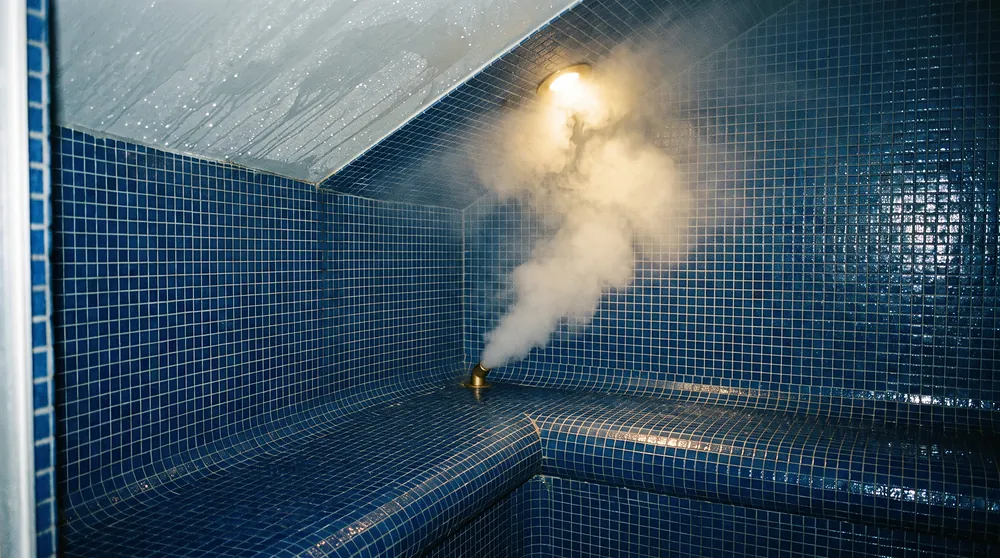
A sauna is a carpentry project: a five-layer sandwich wall with rockwool and a vapor-barrier foil, a cedar or thermowood interior, and a heater on its own dedicated circuit. A steam room is wet work: flawless waterproofing, a floor sloped to the drain, a sloped ceiling so condensation runs down the walls — not onto your head — plus mosaic and a steam generator. Wet work takes longer and is far less forgiving of mistakes: a leak in a steam room means tearing it out.
Electricity: a tie, not a tie-breaker
Both are power-hungry: a 6–9 kW heater and a 6–9 kW steam generator each demand a 7,700–11,000 VA connection with their own breaker and ELCB circuit. If your home's supply is limited, the real alternative is an infrared sauna at 1.7–2.4 kW — the maths is in our article on sauna power requirements.
For Tangerang's climate, which makes more sense?
The "the air here is already humid" argument cuts both ways. Some of our clients in Alam Sutera and Gading Serpong choose a dry sauna precisely for the contrast with the air outside; owners of large master bathrooms often go for a steam room because it blends into the shower zone. In commercial facilities the answer is not "either/or" but "both" — gyms and spas install the two side by side, often adding a cold plunge for the hot-cold cycle. We bundle a complete wellness zone like that on our spa equipment page.
How to decide in three questions
- Which sensation are you after? Dry, wood-scented heat → sauna. An enveloping steam that eases your breathing → steam.
- Where is the space? A dry corner or the garden → sauna. Built into the bathroom → steam.
- Who will use it? A family with varied tastes and the budget to match → consider both in one zone.
Still unsure? Send us a photo of your room and we'll make a free visualization — you'll see for yourself what fits, how much power it needs, and the budget. Final measurements are taken at installation.