Technical · 6 min read
Sauna electrics for Tangerang homes: run the numbers first
A sauna's power needs come down to the heater: a 6–9 kW unit demands a 7,700–11,000 VA PLN connection, while plenty of homes in Tangerang still sit at 2,200–5,500 VA. So before you talk timber and design, three choices have to be made: upgrade your PLN supply, pick a smaller heater, or switch to a 1.7–2.4 kW infrared cabin. This article helps you decide with numbers.
How many VA do you actually need?
A heater runs at almost full power during the warm-up (the first 30–45 minutes), then the thermostat starts cycling on and off. Because your home is also running the air-con, fridge and water pump at the same time, your PLN connection has to be larger than the heater's draw:
| Heater | Cabin | Minimum PLN connection |
|---|---|---|
| 3.6 kW | 2 people, 1.5×1.2 m | 5,500 VA |
| 6 kW | 4 people, 2×2 m | 7,700 VA |
| 8–9 kW | 6–8 people | 11,000 VA |
| 10.5 kW and up | commercial | 3-phase |
The pattern we see on the ground: new homes in the BSD, Gading Serpong and Alam Sutera clusters are usually already at 5,500–11,000 VA — just check the spare capacity. Older houses in Karawaci, Cipondoh and Ciputat often still sit at 2,200–3,500 VA — and that's where the decision has to be made.
Option 1 — upgrade your PLN supply
The process is administrative and the cost follows PLN's official tariff, paid by the homeowner; we help handle the application as part of the project. Once the supply is raised, a 6–9 kW heater is on the table — and with it the classic 70–90°C dry-sauna experience, water ladled over the stones. This is the route our custom sauna clients take most often.
Option 2 — infrared: a way out without an upgrade
Infrared carbon panels pull 1.7–2.4 kW in total — about the same as a big air-con — and run in a 2,200 VA home without any drama. They sit at 45–60°C and the heat goes straight into the body rather than through the air; the experience differs from a dry sauna, but for many people it's just right: longer sessions, sweat still pours. Installed in 1–2 days, around Rp 30–70 million.
What you don't negotiate on: cable, breaker, ELCB
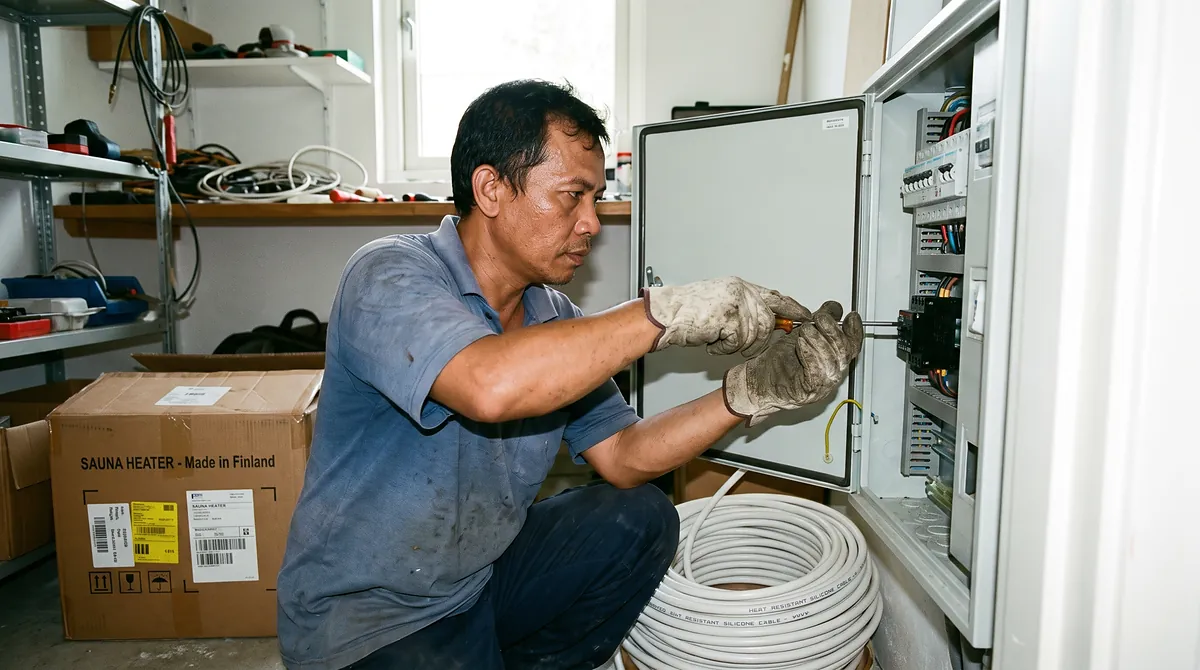
- Heat-resistant cable (SiHF / silicone) inside the hot zone — ordinary PVC cable hardens and cracks at sauna temperatures.
- A separate breaker off the main panel — the heater must not piggyback on a socket circuit.
- ELCB / RCD — an earth-leakage breaker. A hot, humid room with people inside it is the last place to cut corners on this protection.
- Work done by an electrician, not DIY — we're firm on this point, including with readers of our build your own sauna article.
What does it cost to run each month?
For 2–3 sessions a week, the total running cost of a dry sauna — power plus light maintenance — comes to around Rp 200,000–500,000 a month; infrared is leaner, Rp 100,000–250,000. The biggest factor is warm-up time: a cabin with proper insulation (50 mm rockwool + foil) reaches temperature faster and holds heat longer. Cheap insulation is paid for dearly on the bill.
Three real cases from Tangerang homes
The numbers get clearer through examples we run into often:
- New cluster home in BSD, 7,700 VA. Enough for a 6 kW heater in a 4-person cabin, as long as the air-con and pump aren't running together during warm-up. Fix: schedule sessions in low-load hours, or step up to 11,000 VA for peace of mind. No drama.
- Older house in Ciputat, 2,200 VA. Upgrading to 7,700 VA is possible but costs money and time. The owner chose a 2.2 kW infrared sauna — installed in two days, running on the existing supply, panel untouched.
- Shophouse converted into a studio, Gading Serpong. A plan for a commercial 9 kW sauna plus a cold plunge called for a 3-phase assessment. We worked out the total load at the design stage and folded the power upgrade into the quote from the start.
The recurring pattern: new homes are usually ready or nearly ready; older buildings need a decision — upgrade the supply or move to infrared. We help with both — what matters is running the numbers before you buy the heater, not after.
Checklist before you decide
- Check your VA connection in the PLN Mobile app or on the meter.
- Work out the home's peak evening load (air-con, pump, kitchen).
- Decide: upgrade the supply, a smaller heater, or infrared.
- Confirm a cable run from the panel to the cabin is feasible.
- Ask for a quote that lists the electrical work as a separate item.
Send us photos of the cabin spot and your VA figure, and we'll come back with a free visualization from your photo plus a power calculation for each option — final measurements are taken at installation. Ballpark cabin and heater pricing sits on the pricing page — and if your supply turns out to have headroom, add a cold plunge while you're at it: its chiller only draws about as much as an air-con unit.